We Ranked 3 Toronto Sites Without Building a Single Backlink
Almost every SEO blog tells you backlinks are the most important ranking factor. For local SEO, that is wrong. We ranked three GTA sites to top 3 without an active link campaign. Here is what we did instead.
Expert Content
Written by Abdul Jaafar, local SEO specialists with over 5 years of experience helping Toronto businesses rank on Google. All strategies are tested and proven to work in the competitive GTA market.
We Ranked 3 Toronto Sites Without Building a Single Backlink
Local link building in Toronto is one of those SEO topics where the conventional wisdom and the actual evidence diverge. Almost every generic SEO blog will tell you that backlinks are the single most important ranking factor and that you need a sustained outreach campaign to build them. For local SEO, that's wrong, or at least incomplete.
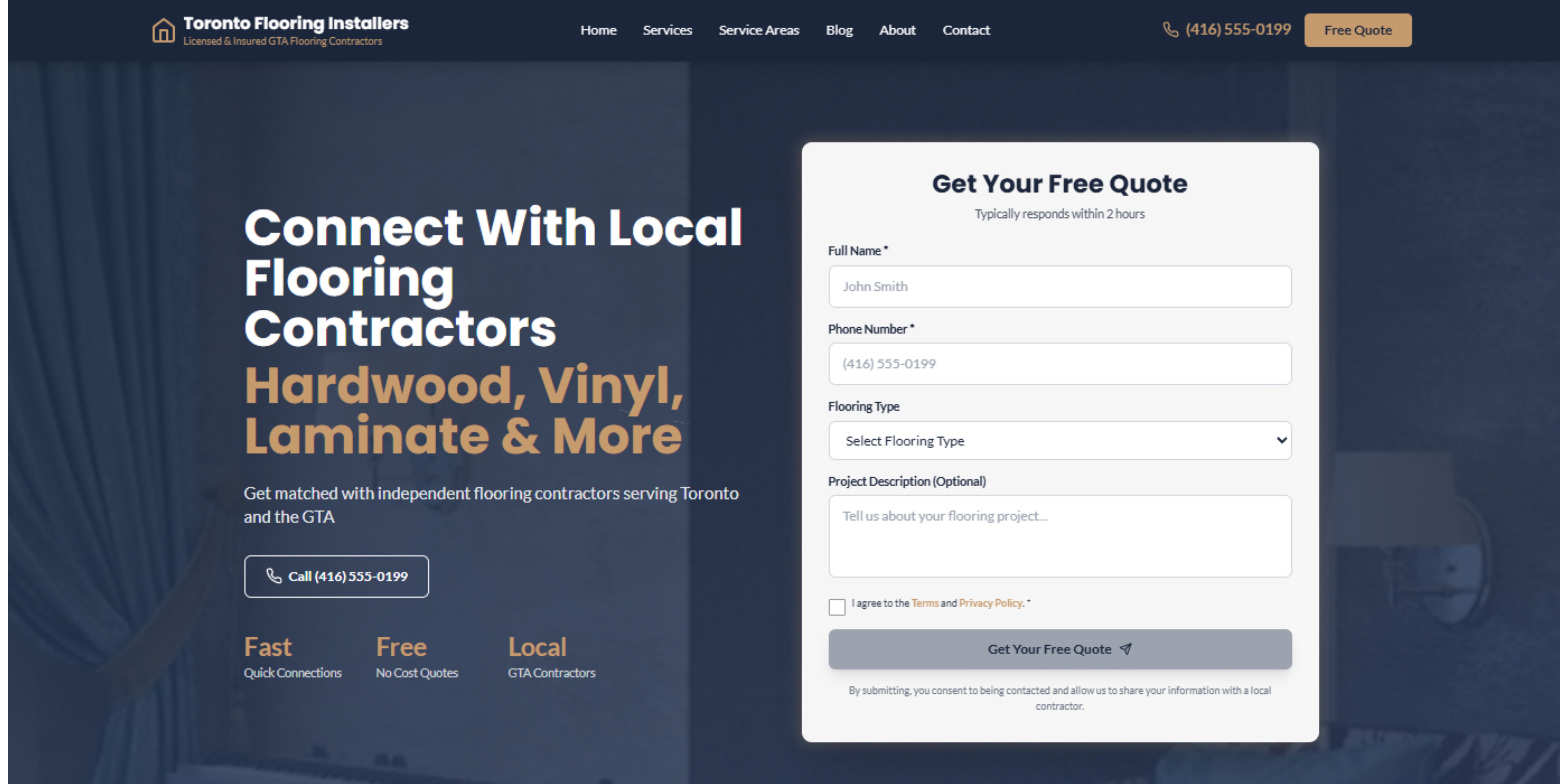
We've taken three GTA sites — flooringinstallerstoronto.com, gtageneratorrepair.com, and a Toronto truck repair site — to top-3 rankings for their primary keywords without an active link-building campaign. Zero outreach. Zero guest posts. Zero paid placements. They've collected backlinks organically over time, but those came after rankings, not before.
This isn't a theoretical claim. It's three sites we own and operate as part of our lead-gen portfolio. The data is what it is.
What we did instead
If we weren't building backlinks, what were we doing? Three things, in roughly equal measure.
1. Topical authority through depth
Instead of building one or two pages per service, we built clusters. Flooringinstallerstoronto.com has pages for hardwood, vinyl plank, laminate, engineered wood, and tile installation — each with a real page targeting real keywords, plus city pages for Toronto, Mississauga, Brampton, Vaughan, and Oakville.
Each individual page on its own wouldn't rank for much. Together they signal to Google that the site is genuinely about flooring installation in the GTA. That topical depth is what most "thin sites" never accumulate, and it does most of the work that backlinks are credited with.
2. Aggressive in-body internal linking
The most impactful change we make on local sites is converting structural navigation links (header, footer, related-content cards) into in-body contextual links inside paragraphs. Every page on our lead-gen sites contains 3-5 in-body links to other pages on the same site, with descriptive anchor text.
That's the pattern this post follows. Every link from the body of a page to another page on the site signals topical relationship to Google more strongly than a footer or sidebar link does. We picked this up from the Reboot link experiment data, but it shows up consistently in our own ranking patterns: pages with strong in-body internal linking outrank pages with the same external link profile but weaker internal linking.
3. Outbound dofollow links to authoritative sources
Counterintuitively, sending links OUT to authoritative sources improves rankings. The Reboot 10-site experiment found every site with outbound links outranked the sites without them. We default to dofollow on all our outbound links and target Google documentation, industry research, and tool documentation as the receiving sites.
Every page on our services hub and most of our blog posts include 2-3 outbound dofollow links. Anchor text is descriptive, never "click here." We don't link to competitors and we don't link to low-quality directories.
Why this works in local but not always in other niches
Local SEO has a quirk that makes the no-link approach more viable than it would be for, say, an e-commerce site competing nationally. The local pack ranks heavily on Google Business Profile signals — categories, reviews, photos, posting cadence — alongside on-page content. Backlinks matter less to the Map Pack than they do to organic results for high-volume national queries.
Combine that with the relatively low SEO sophistication of most local-business competitors and the timeline math is friendly. We can typically rank a properly built local site within 4-12 weeks without external links, where the same approach for a national B2B site would take much longer and likely require links eventually.
What we'd add if we were starting today
The no-backlinks approach is what works for ranking. Once a site has rankings and is producing leads, we DO eventually add link-building activity, but it's not where we start. The order matters:
- Site architecture: real HTML, clean canonicals, fast load.
- Page-level keyword targeting and topical depth.
- GBP fully optimized with steady review velocity.
- In-body internal linking across all pages.
- Outbound dofollow links to authoritative sources.
- Then — and only then — link building outreach as the leverage on top.
If you're a Toronto service business and you've been told you need 30 backlinks before you'll rank, that's likely advice from a non-local-specific playbook. Most of our Toronto and Mississauga clients rank without active link building. The mechanics are different for local than for general SEO.
Get in touch if you want a real audit on your specific situation. Or read our breakdown of the GBP setup that drove 47 calls in 30 days to see exactly how Profile-driven rankings work in practice.
For independent data on how outbound links affect rankings, the Reboot 10-site outbound link experiment is the canonical study. For Google's own guidance on links, Google Search Central's documentation on links is worth reading once and not panicking about.
Ready to Improve Your Local SEO?
Get expert help implementing these strategies for your Toronto business.
Get Free Consultation